Chapter 02 · 1543–1641
Cross, Gun, and Kingdom
Contact made Japan more observable—and more useful to competing projects.
Portuguese traders reached Japan in 1543; Francis Xavier followed in 1549. Firearms, Christian missions, maritime trade, and civil war now connected European observers to Japanese rulers and ports. The resulting archive is richer than the archive of Cipangu, but it is not neutral. It was made by people trying to sell, convert, govern, or secure an alliance.
Evidence set6 objects · 1580–1627
Method noteEuropean reports dominate the surviving printed record. A Japanese-made gun and folding screen remain in the evidence set to show that objects and images moved through choices made on both sides of the encounter.
The evidence sequence
How encounter became a programme
Scroll through 4 surviving objects. The image changes as the argument advances from one frame to the next.
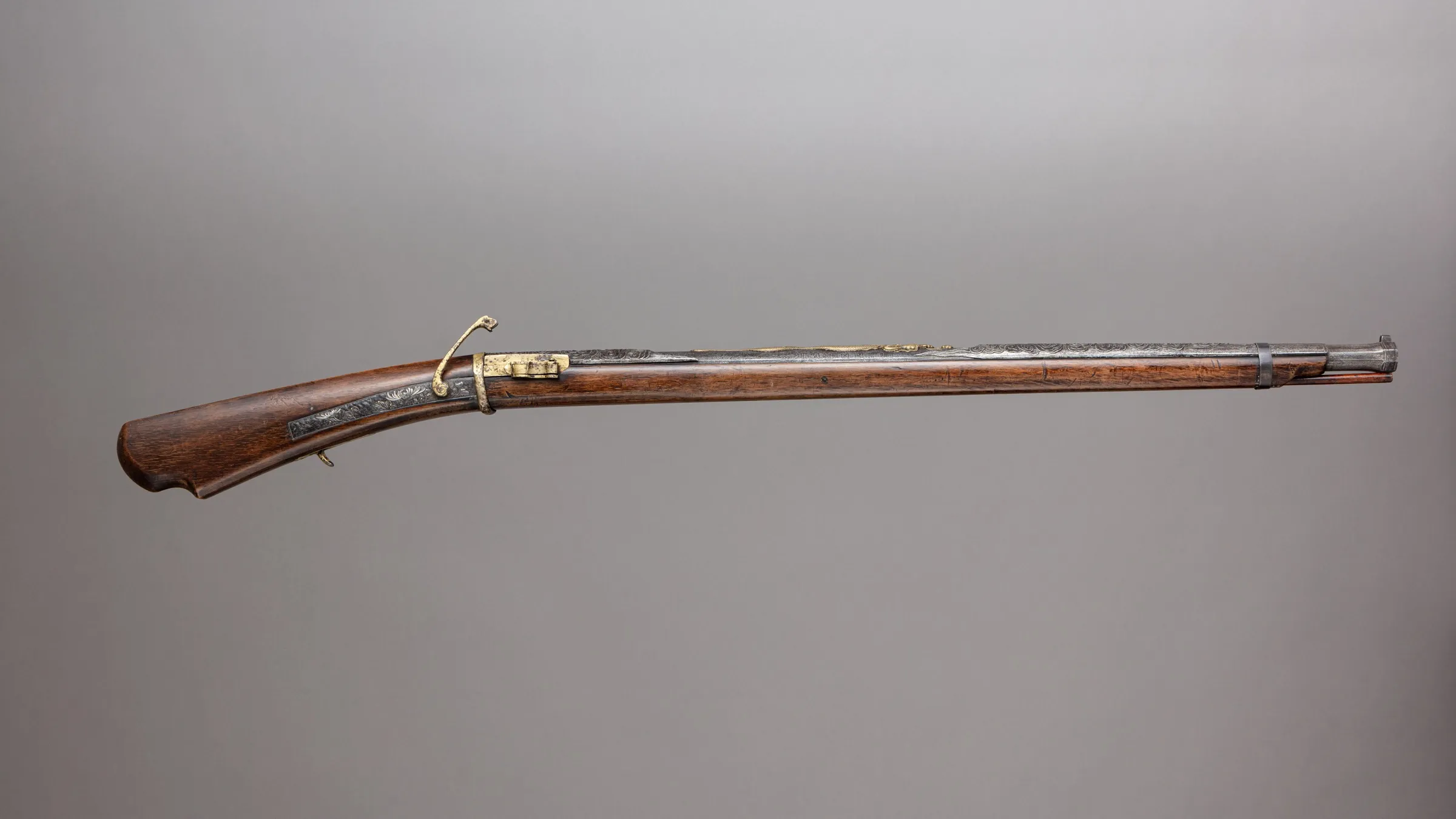
01 / Gun
An imported mechanism becomes Japanese
Matchlock technology arrived through Portuguese trade and was quickly copied by Japanese makers. This gun, associated with the warlord Horio Yoshiharu, belongs to the generation in which a foreign mechanism became part of domestic warfare and elite material culture.
Close readingThe object is not a Portuguese gun preserved unchanged. Its long local working life and Japanese ownership make adoption visible as selection, manufacture, and use—not passive reception.
Open source record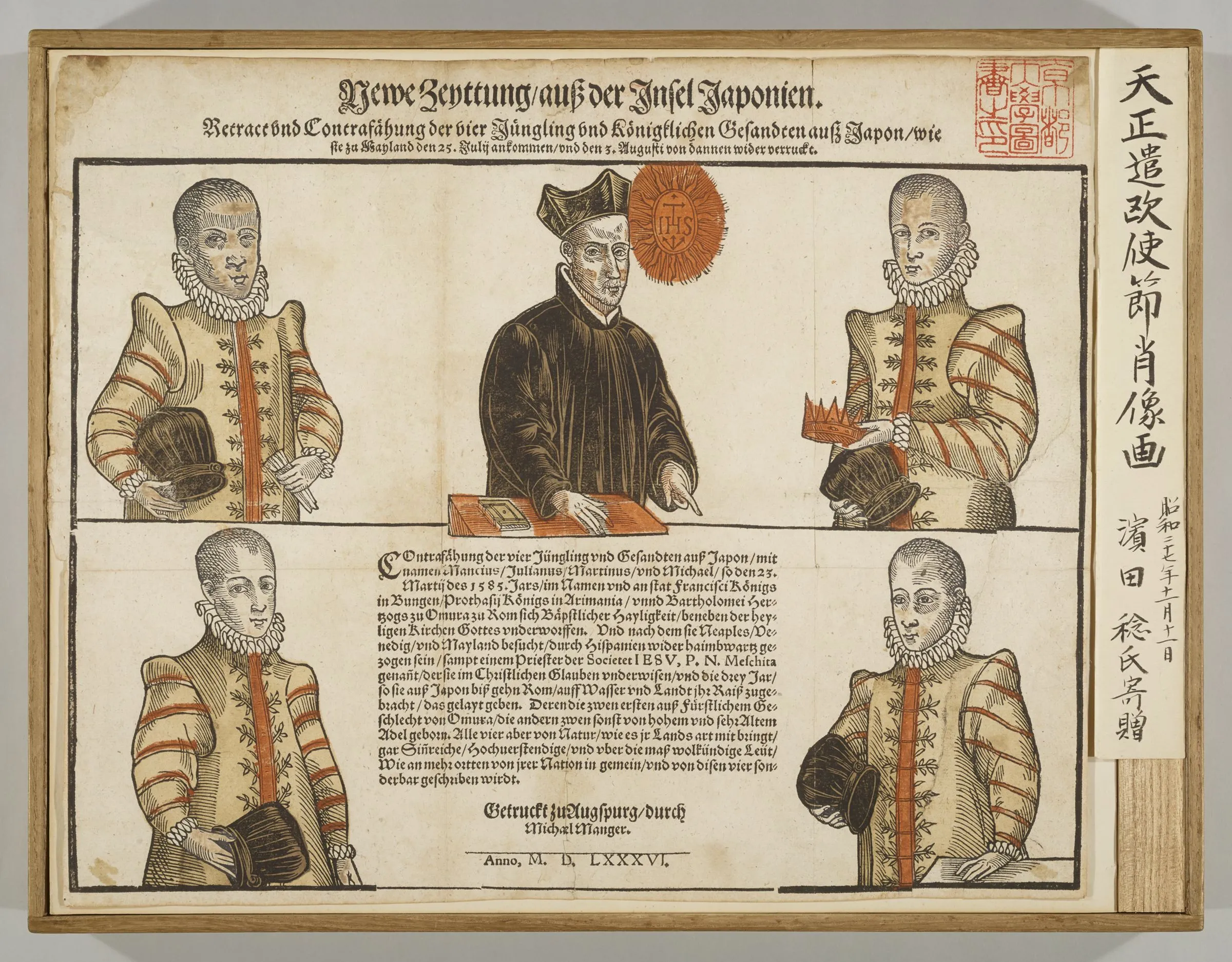
02 / Embassy
Envoys become proof
Four young envoys sent by Christian lords in Kyushu reached Europe in 1584 and arrived in Rome in 1585. An Augsburg broadside presented their arrival as news from Japan and as evidence that the Jesuit mission had gained noble allies.
Close readingRuffs, fitted doublets, a crown, and the centrally placed Jesuit make the delegation legible through European court and Catholic signs. The print reports an encounter while also staging its preferred meaning.
Open source record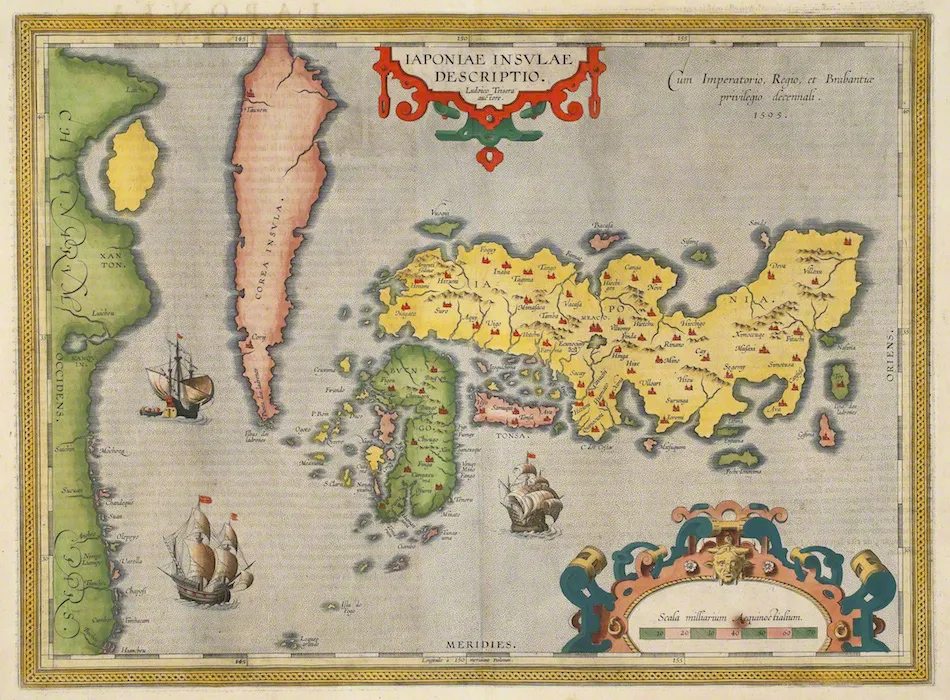
03 / Kingdom
Mission networks redraw the islands
Luís Teixeira's map, first issued by Abraham Ortelius in 1595 and shown here in a 1602 edition, gave European atlas readers a standalone Japan crowded with provinces, towns, and routes.
Close readingDense names create an impression of mastery, yet the distorted archipelago and island-shaped Korea reveal a composite geography. Japanese information circulated through Portuguese and Jesuit networks inside a European atlas frame.
Open source record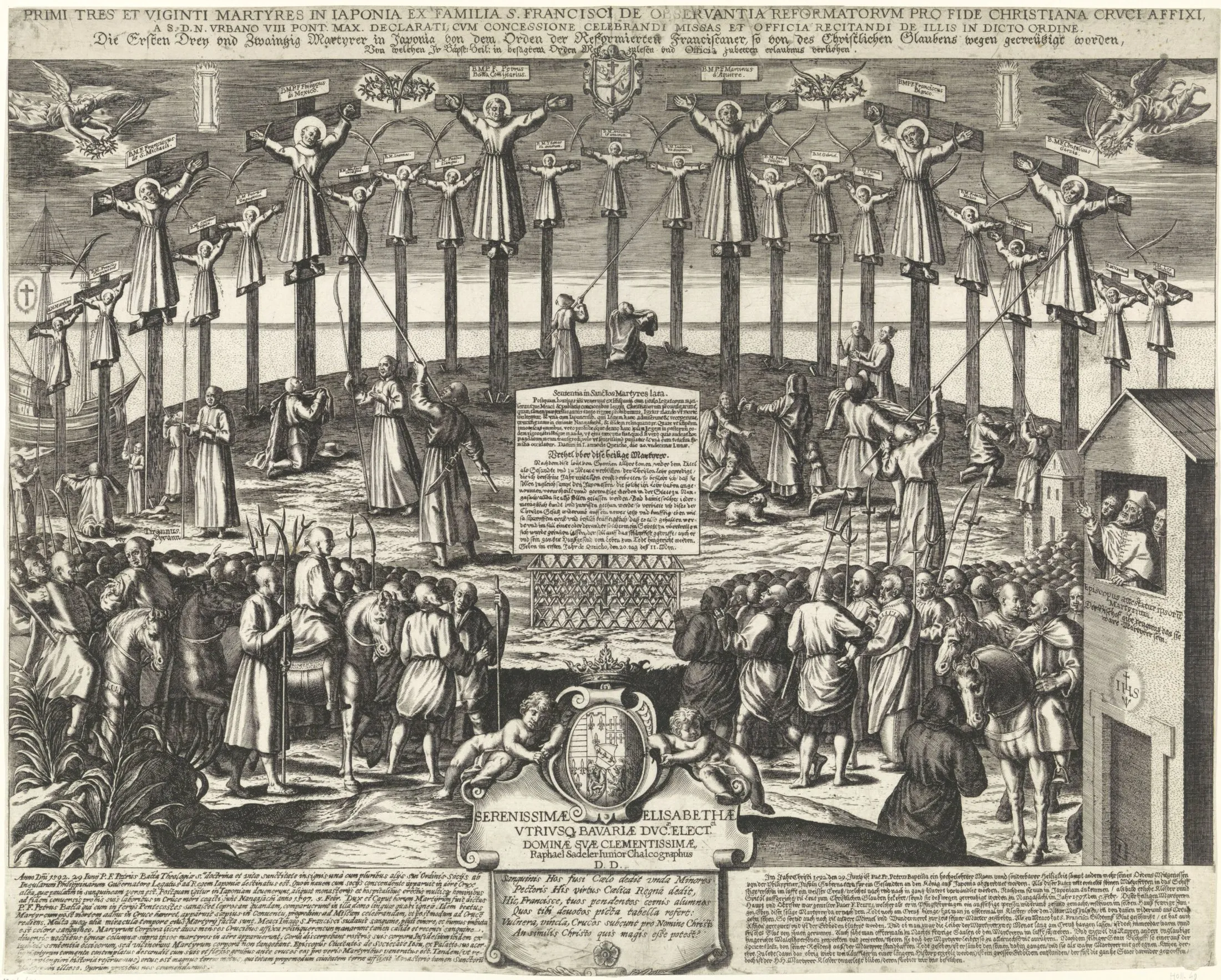
04 / Martyrdom
Conversion becomes persecution
After the execution of twenty-six Christians near Nagasaki in 1597, European Catholic print culture turned the event into a durable story of sanctity. Sadeler's later engraving followed Pope Urban VIII's beatification of twenty-three Franciscan-associated martyrs.
Close readingHalos, angels, symmetrical crosses, and inscribed names reorganise an execution into a confessional diagram. Japan is no longer only a field ready for conversion; it is also pictured as a kingdom that produces martyrs.
Open source recordCounter-reading
Contact did not create a single gaze
The archive does not divide cleanly into active Europeans and passive Japanese. Weapons were remade locally, embassies pursued Japanese political goals, and port screens turned arriving Europeans into spectacles for Japanese patrons. Every object records an encounter shaped by unequal but multiple agendas.
- 01Japanese rulers could adopt firearms while regulating the traders and missionaries who carried them.
- 02European presses recast diplomatic visitors as proof of Christian progress, even when embassies also pursued commerce and alliance.
- 03The restrictions of 1639–1641 narrowed foreign contact into authorised channels; they did not make Japan disappear from connected histories.
Evidence register
Sources in this chapter
- 01Matchlock Gun of Horio YoshiharuJapanese maker; associated with Horio Yoshiharulate 16th–early 17th centuryImported mechanism, local weapon
- 02Newe Zeyttung auss der Insel JaponienMichael Manger, printer1586Embassy as mission news
- 03The First Map of Japan in the AtlasEdited by Abraham Ortelius; drawn by Luís Teixeira1602 edition; map first issued 1595A kingdom made mappable
- 04Twenty-three Christian Martyrs in JapanRaphaël Sadeler II1627–1632; depicts the 1597 executionsJapan as persecuting kingdom
- 05Portrait of Hasekura TsunenagaRaphaël Sadeler II1615Diplomat between visual systems
- 06Arrival of the EuropeansJapanese artistfirst quarter 17th centuryThe arrivals become a spectacle