Chapter 05 · 1868–1905
Picturesque and Modern
Modern Japan and picturesque Japan were not opposites. Exhibitions, cameras, and markets produced them together.
After the Meiji Restoration of 1868, the new government dismantled domains, built national institutions, and pursued railways, factories, schools, and military reform. It also entered the international exhibition system. At Vienna in 1873, officials and advisers selected gardens, architecture, and industrial arts to make Japan distinctive abroad. At home, national industrial exhibitions turned imported building forms and new institutions into popular spectacle. Photographers, dealers, artists, and collectors simultaneously made garments, crafts, and occupations portable. The modern state did not simply discard tradition; it selected, formatted, and circulated it.
Evidence set6 objects · 1870–1881
Method noteWorld-fair photographs, museum collections, and commercial albums preserve what states, institutions, and buyers chose to display and keep. They do not offer a social survey of Meiji Japan. Japanese officials, artists, photographers, and artisans were active producers in this archive, but foreign advisers, exhibition categories, and consumer demand also shaped what became visible.
The evidence sequence
One exhibition system, two Japans
Scroll through 4 surviving objects. The image changes as the argument advances from one frame to the next.
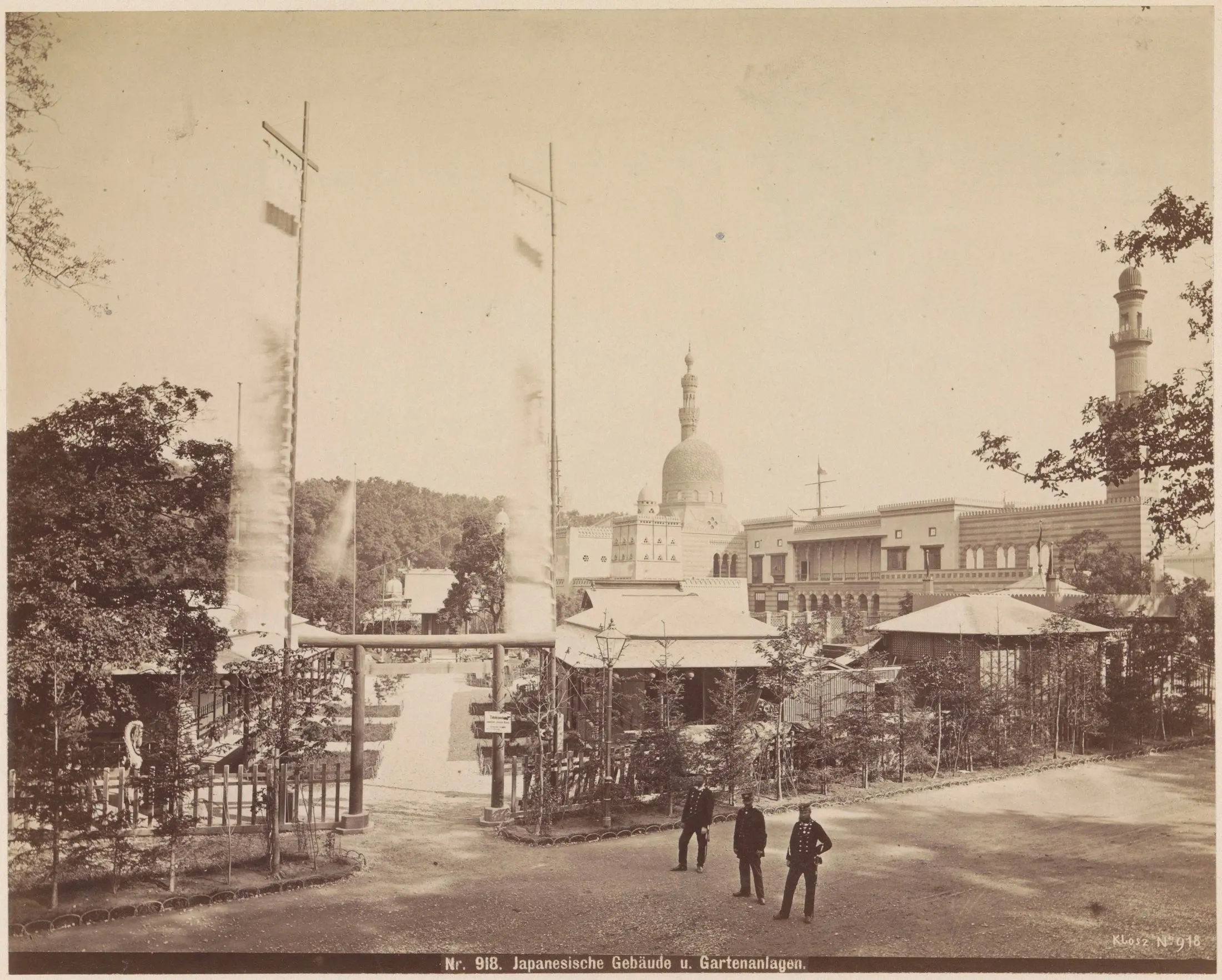
01 / Pavilion
A modern state performs curated tradition
The 1873 Vienna World’s Fair was the first international exposition in which the Meiji government officially participated. Japan built a shrine, garden, and pavilion and emphasised industrial arts that could appear both nationally distinctive and commercially desirable. The display entered a modern system of diplomacy by turning selected architecture and craft into a legible national style.
Close readingA torii frames the foreground while low roofs and a planted garden sit beneath the domes and minaret of a neighbouring pavilion. The photograph makes national difference spatially comparable. Japan looks picturesque here because a modern exhibition has organised it to be seen that way.
Open source record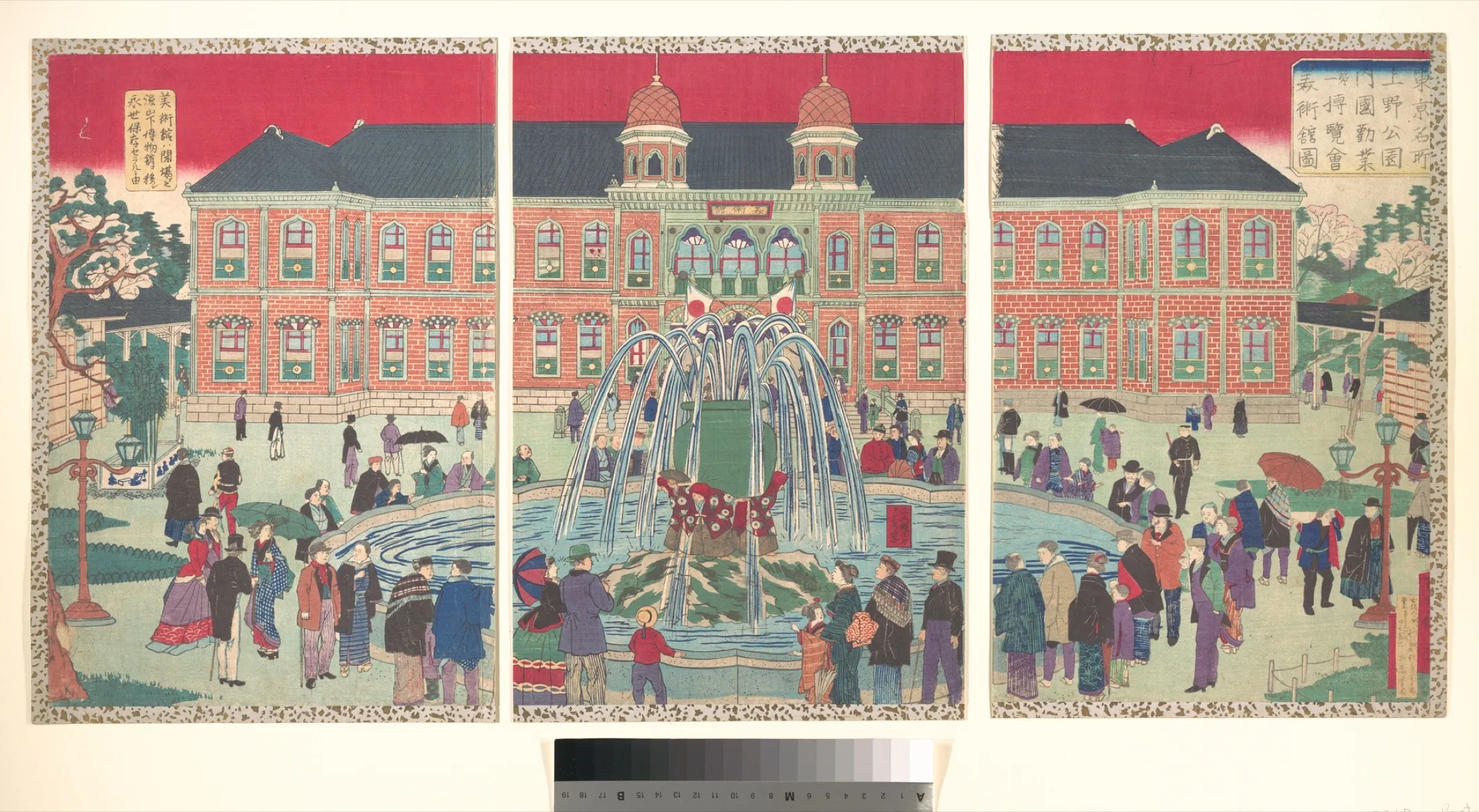
02 / Industry
Modernity becomes a popular print
Utagawa Hiroshige III pictured the museum at Japan’s Second National Industrial Exhibition in Ueno in 1881. The red-brick façade, fountain, flags, street lamps, and mixed crowd present new public institutions as attractions within everyday urban life.
Close readingThe Western-style building stretches across an unmistakable woodblock triptych. Flat colour, visible sheet divisions, patterned clothing, and the crowded foreground do not disappear before modern architecture; they make it intelligible. Industrial progress is circulated through an established print medium rather than replacing it.
Open source record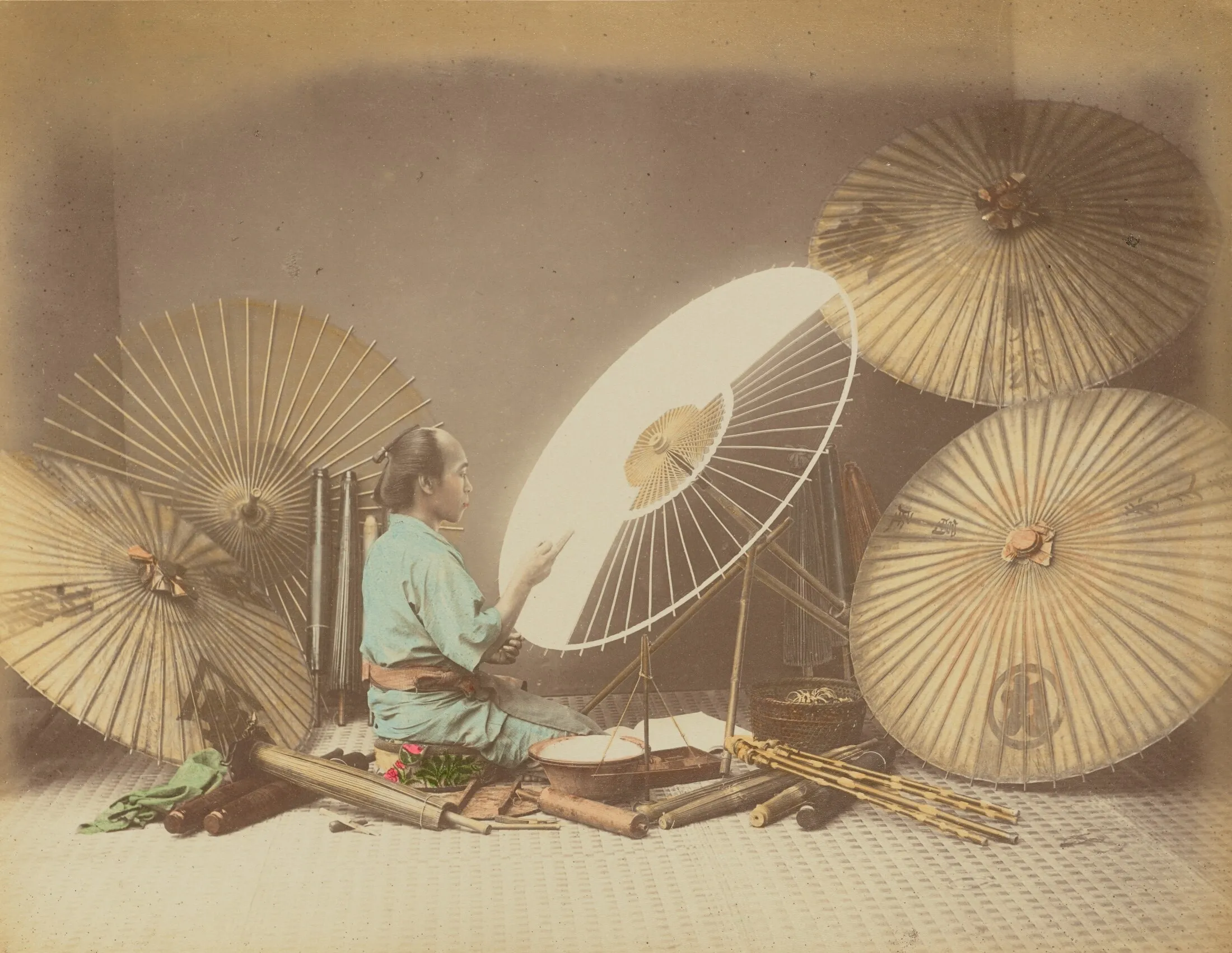
03 / Album
Contemporary labour becomes timeless custom
Kusakabe Kimbei’s hand-coloured photograph belongs to a commercial repertoire of Japanese places, occupations, and customs. It preserves the tools and skilled sequence of umbrella making, yet the studio arrangement also packages work as a self-contained scene for viewers who could carry Japan away in an album.
Close readingUmbrellas radiate around the seated maker while the shallow, nearly blank backdrop removes street, workshop, and market. The hand-applied colour intensifies material detail, but the careful symmetry and suspended gesture turn living labour into a picturesque type detached from the industrialising economy around it.
Open source record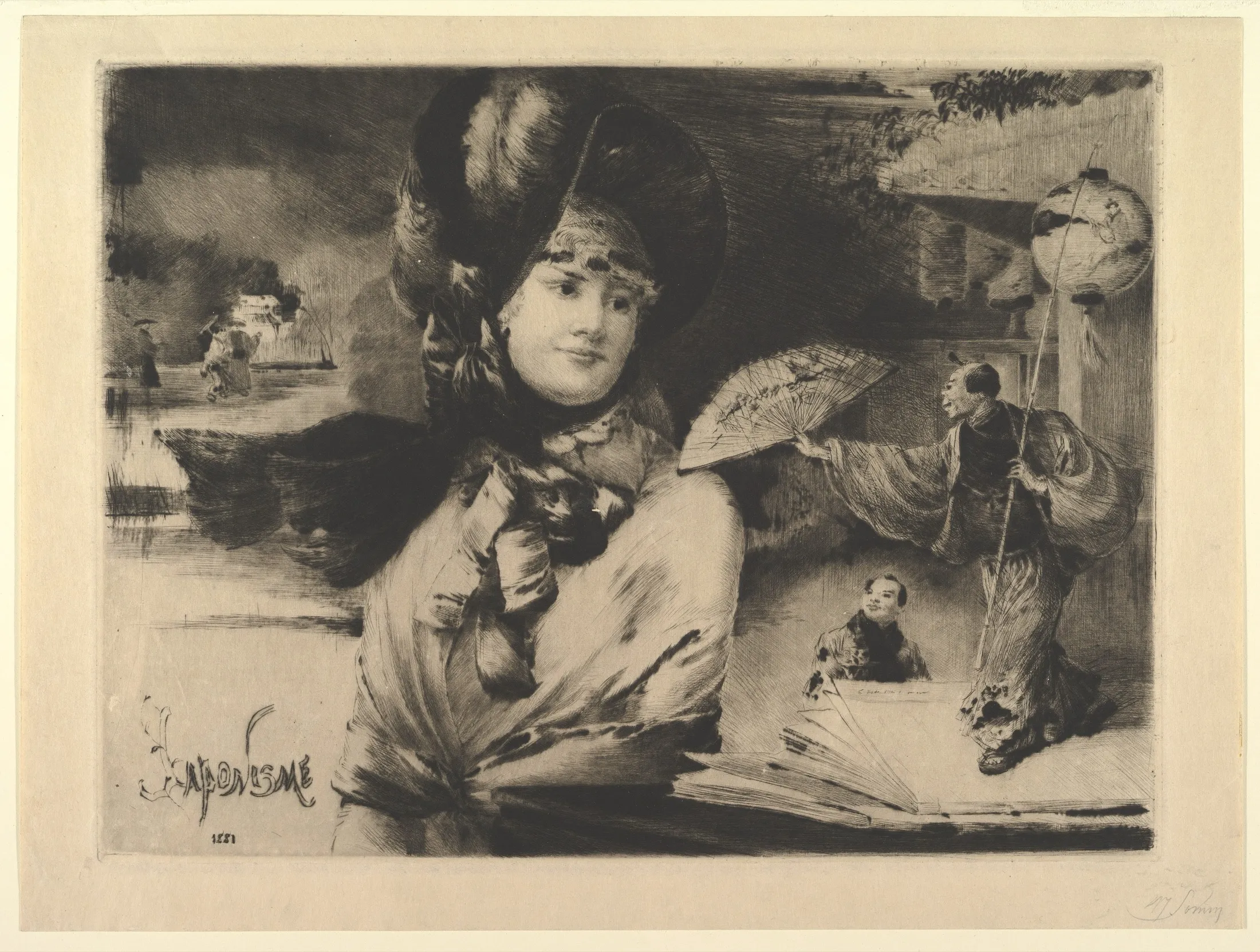
04 / Fantasy
Objects remake people as décor
Henri Somm’s 1881 drypoint gives the European craze its contemporary name: Japonisme. A fashionable white woman is surrounded by fans, a lantern, a teacup, folios, and miniature Japanese men. Japanese material culture has become intimate with French modern taste, but the intimacy is unequal.
Close readingThe woman controls the composition’s scale while the Japanese figures shrink to the size of souvenirs standing on papers and an open album. One offers a fan and another a cup. Objects and people blur into a consumer fantasy, exposing how aesthetic admiration could coexist with dehumanisation.
Open source recordCounter-reading
A style was never the whole society
“Picturesque Japan” was not merely imposed from outside, and “modern Japan” was not a complete description from within. Government bureaux, photographers, print publishers, artisans, dealers, and foreign consumers all participated from unequal positions. Their successful images leave political conflict, labour conditions, rural change, and Japan’s own expanding imperial ambitions largely outside the frame.
- 01World fairs were strategic state projects and commercial markets, not neutral surveys; the 1873 display selected forms that could distinguish Japan and sell.
- 02Tourist photographs could record real techniques while staging, hand-colouring, captions, and album sequences recoded contemporary workers as timeless social types.
- 03Japonisme changed European art and design, but images such as Somm’s could enlarge the Western consumer while miniaturising Japanese people into accessories.
Evidence register
Sources in this chapter
- 01View of the Japanese Pavilion at the Vienna World’s FairKlösz (named on the object)1873Tradition curated as modern national display
- 02Illustration of the Museum at the Second National Industrial Exhibition in UenoUtagawa Hiroshige III1881Industrial modernity made into popular spectacle
- 03Umbrella MakerKusakabe Kimbei1870s–1890sContemporary labour packaged as timeless custom
- 04JaponismeHenri Somm1881Consumer desire miniaturises people into décor
- 05The Japanese RobeAlfred Stevensca. 1872Japanese dress becomes Parisian fashion
- 06Incense BoxOgawa Shōmindated 1876Craft mastery becomes collectible national style