Chapter 07 · 1931–1945
Empire and Enemy
The enemy image grew from real imperial aggression, but wartime media made it portable—moving from the Japanese state and military to any body read as Japanese.
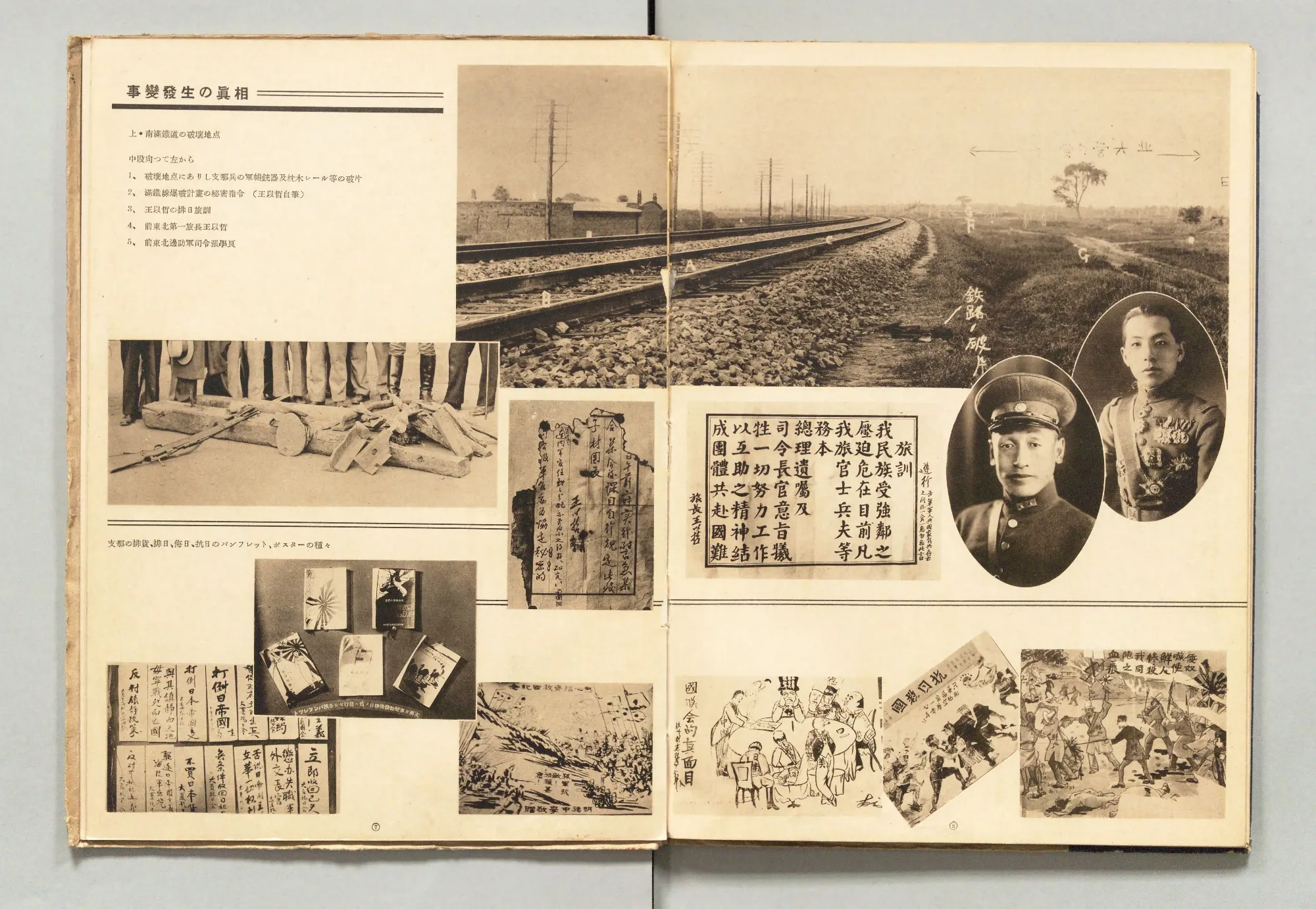
In September 1931, officers of Japan’s Kwantung Army staged an explosion beside the South Manchuria Railway and used it as the pretext for occupying Manchuria. The following years brought the puppet state of Manchukuo. Japan escalated its war in China to full scale in 1937 and later expanded the conflict across Asia and the Pacific. After the attack on Pearl Harbor in December 1941, the United States entered a war that China had already been fighting for years. Allied images now had concrete aggression to show, but they rarely stopped at naming policies, commanders, or armed forces. Posters and government orders converted a military enemy into a racial type that could be recognised in a factory, at a railway station, or in a neighbour.
Evidence set6 objects · 1932–1943
Method noteContent note: This chapter includes photographs of wartime violence and forced removal, as well as a propaganda poster built from grotesque anti-Japanese caricature. It reproduces the poster for critical analysis, not endorsement. The evidence distinguishes the Japanese state and imperial military from Japanese civilians, colonial subjects, and people of Japanese ancestry outside Japan. Chinese, Korean, Southeast Asian, and Pacific peoples were subjects of invasion and occupation, not background to a U.S.–Japan war.
The evidence sequence
Pretext staged, attack witnessed, ancestry punished
Scroll through 4 surviving objects. The image changes as the argument advances from one frame to the next.
01 / Pretext
A railway company publishes “the truth”
The South Manchuria Railway was both a corporation and an instrument of Japanese empire. Its 1932 photographic album presented the Manchurian Incident as an evidentiary case for Japanese action. This spread, headed “The Truth of the Incident’s Outbreak,” assembled the railway site, alleged sabotage material, documents, portraits, and Chinese anti-Japanese print into a single official-looking explanation.
Close readingThe rail line recedes with surveying clarity across the upper half, while arrows and labels turn the landscape into a diagram. Below it, fragments, papers, faces, and cartoons are arranged like exhibits. The abundance of small proofs performs certainty, yet the page never discloses that Kwantung Army officers had engineered the explosion used to justify occupation. A staged pretext becomes a staged archive.
Open source record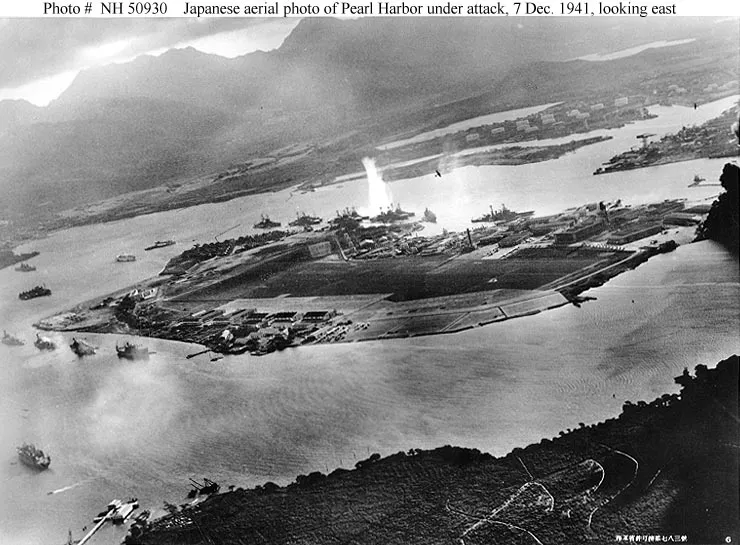
02 / Attack
An attacking camera records the target
On December 7, 1941, Japanese carrier aircraft attacked Pearl Harbor, killing military personnel and civilians and bringing the United States into the war. This photograph was taken from a Japanese aircraft during the torpedo attack. Captured and preserved in an American naval collection, it is at once an operational view, a record of violence, and evidence later absorbed into the Allied account of the enemy.
Close readingFord Island fills the centre while moored ships form exposed rows on both sides. A white plume marks a torpedo strike on USS West Virginia; aircraft remain visible over the harbour. The high oblique view turns ships and shore into a target system. Unlike a caricature, the photograph names a specific act by specific armed forces—but its circulation after the attack could still help make “Japanese” a category wider than the combatants shown.
Open source record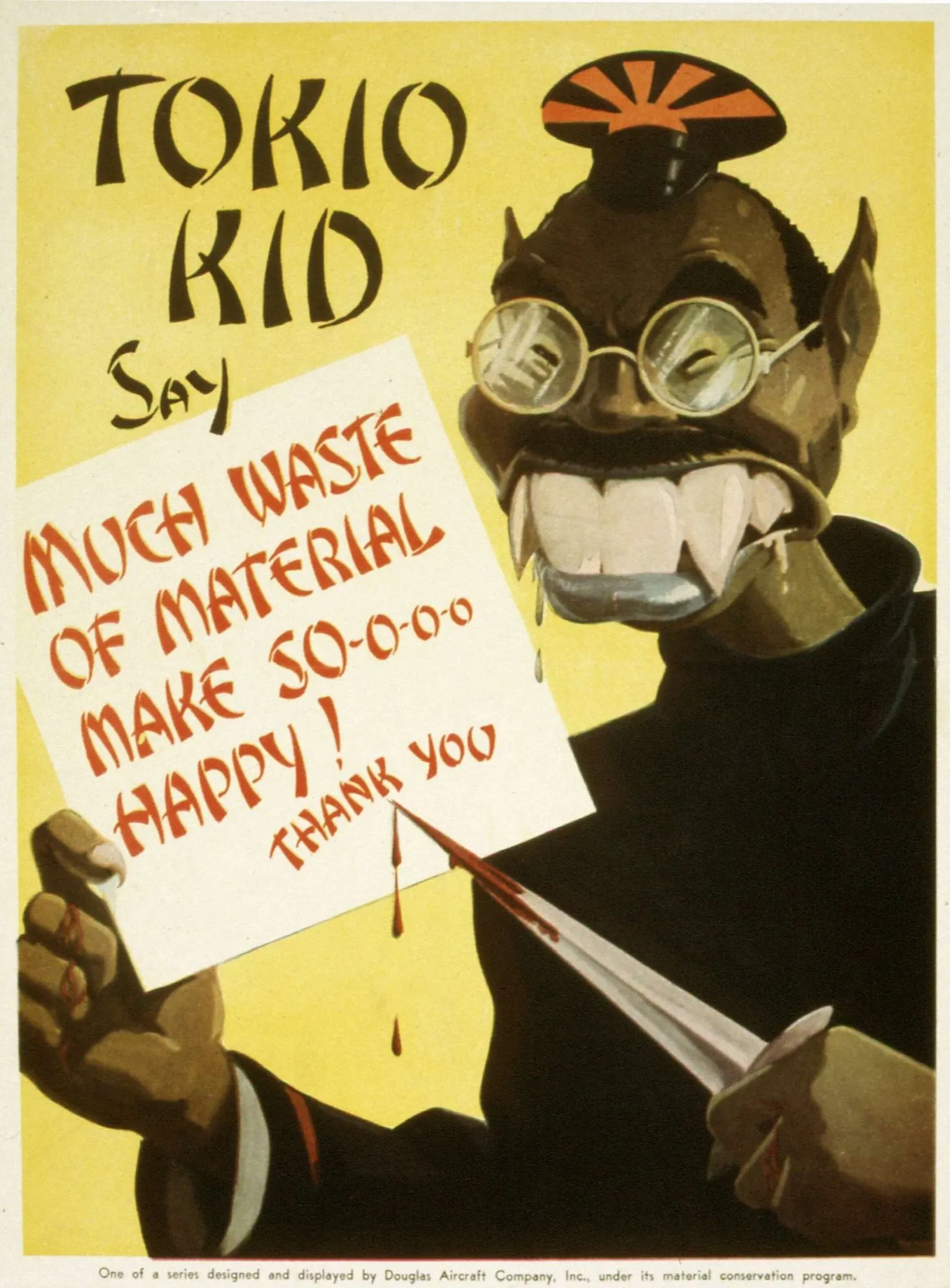
03 / Caricature
The enemy enters the factory as a racial body
Douglas Aircraft used the recurring “Tokio Kid” character to discipline workers around waste, tools, and production. The material-conservation poster imagines that every discarded resource pleases an enemy saboteur. Its lesson depends on converting Japan into a grotesque face whose racial features, language, uniform, and weapon are made interchangeable.
Close readingA yellow field, enlarged teeth, slanted spectacles, pointed ears, rising-sun cap, and bloodied knife compress difference into instant recognition. The broken English on the placard pretends to quote the figure while denying him an intelligible voice. The poster does not identify a military unit or policy; it mobilises productivity by teaching workers that an exaggerated racial type is always watching.
Open source record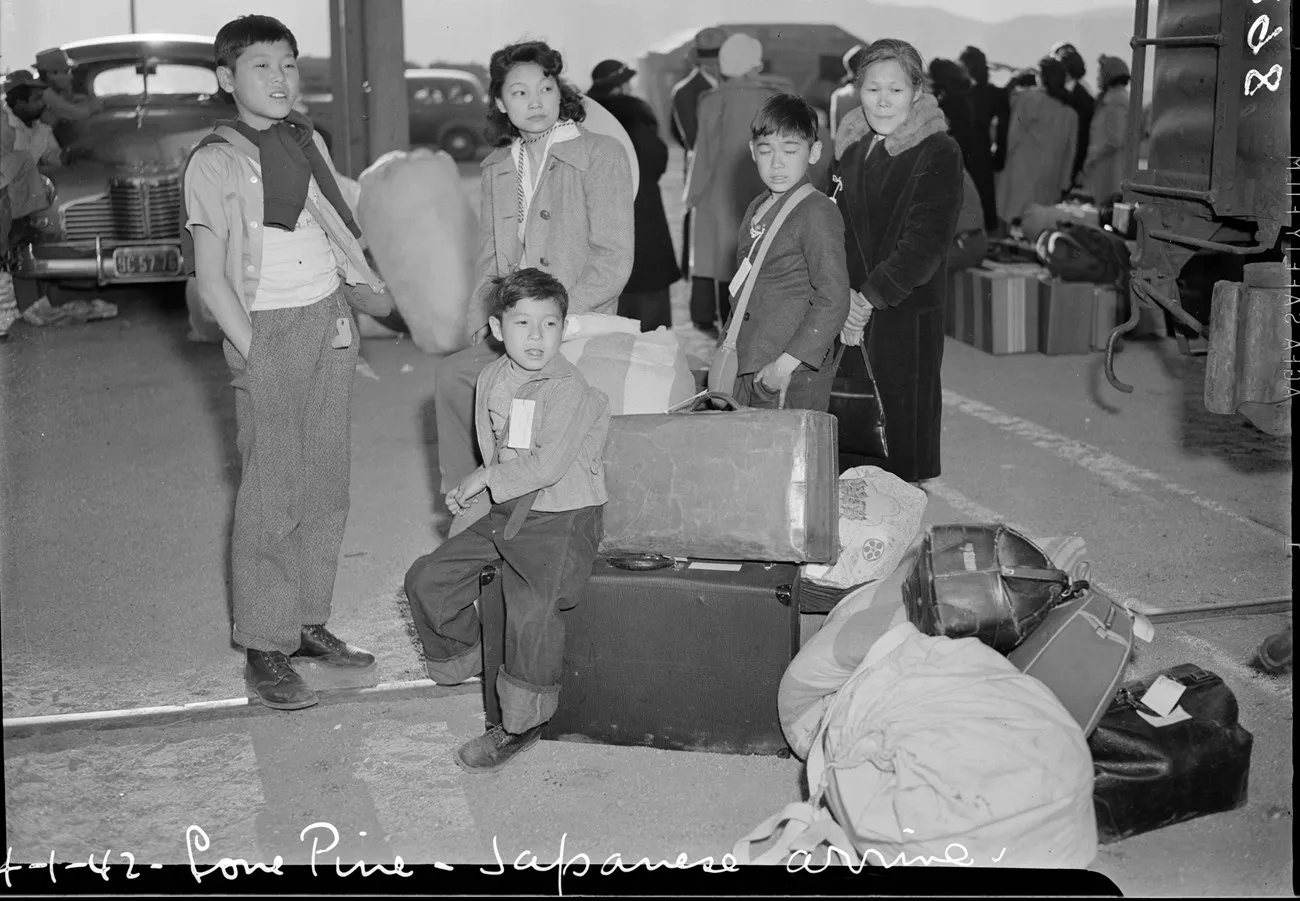
04 / Removal
The enemy category crosses into civilian life
Executive Order 9066 did not name Japanese Americans, but military exclusion orders issued under it forced people of Japanese ancestry from the West Coast into assembly centres and incarceration camps. Clem Albers photographed unidentified Japanese American women and boys at Lone Pine on April 1, 1942, waiting with tagged luggage before transport to Manzanar.
Close readingThe group awaiting transport stands amid suitcases, bedding, vehicles, and other displaced people. Several children wear numbered tags; one boy rests against luggage that defines the limits of what they were permitted to carry. The handwritten edge note records date and place with administrative brevity. Nothing in the photograph evidences allegiance to Japan. It evidences how ancestry had been made sufficient for removal.
Open source recordCounter-reading
Naming aggression does not require racialising ancestry
Japan’s invasion and occupation of Asian and Pacific territories were concrete state projects carried out by identifiable institutions. Anti-Japanese racism did not invent that violence, but the violence did not make racial caricature or collective punishment accurate. The 1942 order and the 442nd Infantry photograph expose how the United States could incarcerate people by ancestry while simultaneously training Japanese American citizens as soldiers.
- 01The Manchurian album shows imperial power producing its own evidence: source criticism must identify the institution arranging the page, not simply repeat its caption.
- 02Pearl Harbor was a specific military attack, not proof of an inherited racial character. Precision about perpetrators strengthens rather than weakens an account of responsibility.
- 03Allied propaganda often collapsed government, military, language, face, and ancestry into one portable enemy. That compression made civilian discrimination appear like mobilisation.
- 04Japanese American service did not purchase the community’s right to citizenship, and resistance to incarceration also belongs in the record. The 442nd photograph demonstrates difference within the category that propaganda treated as uniform.
Evidence register
Sources in this chapter
- 01“The Truth of the Incident’s Outbreak,” from Photographic Album of the Manchurian IncidentSouth Manchuria Railway Company, General Affairs Department, General Affairs Section1932A colonial corporation stages the pretext of occupation as evidence
- 02Pearl Harbor Attack, 7 December 1941Imperial Japanese Navy, photographer unknownDecember 7, 1941A Japanese operational view becomes American evidence of attack
- 03“Tokio Kid Say—Much Waste of Material Make So-o-o-o Happy!”Douglas Aircraft Companyca. 1942–1945Factory discipline is attached to a grotesque racial enemy
- 04Evacuees of Japanese Ancestry Awaiting Buses for Manzanar at Lone PineClem Albers, photographer; U.S. War Relocation AuthorityApril 1, 1942Ancestry becomes sufficient evidence for forced removal
- 05Executive Order 9066Franklin D. Roosevelt, President of the United StatesFebruary 19, 1942General security language authorises racialised exclusion
- 06Company E, 442nd Infantry Regiment, in Formation at Camp ShelbyPvt. Raymond D’Addario, U.S. Army Signal CorpsMay 13, 1943Japanese American soldiers expose the limits of a racial enemy category