Chapter 06 · 1905–1931
Model Power, Yellow Peril
Admiration and fear were not opposite reactions to modern Japan. Both measured its power against a racial and imperial order built to keep Asia subordinate.
Japan’s defeat of Qing China in 1895 and imperial Russia in 1905 unsettled a hierarchy in which modern military power was presumed to be Western. Foreign newspapers, illustrated magazines, and diplomatic photographs placed Japan among the great powers, often with genuine admiration. Yet the same images retained a racial grid of “white” and “yellow,” and Japan’s annexation of Korea demonstrated that recognition was being won through empire. In the United States, conflict with the Japanese state, competition on the Pacific coast, and hostility toward Japanese migrants were repeatedly collapsed into one menace. By 1924, that collapse had become federal law.
Evidence set6 objects · 1904–1924
Method noteContent note: This chapter reproduces historical racial labels and discriminatory legal language in order to analyse how they worked; it does not endorse them. The evidence distinguishes the Japanese state and its imperial institutions from Japanese migrants and their descendants, and it treats Korean people under colonial rule as subjects of coercion rather than scenery in Japan’s rise. Illustrated press, official albums, and legislation record what editors and states wanted audiences to see, not a complete account of Japanese, Korean, Chinese, or diasporic experience.
The evidence sequence
Power recognised, empire exercised, race administered
Scroll through 4 surviving objects. The image changes as the argument advances from one frame to the next.
01 / Race
A war becomes “white” against “yellow”
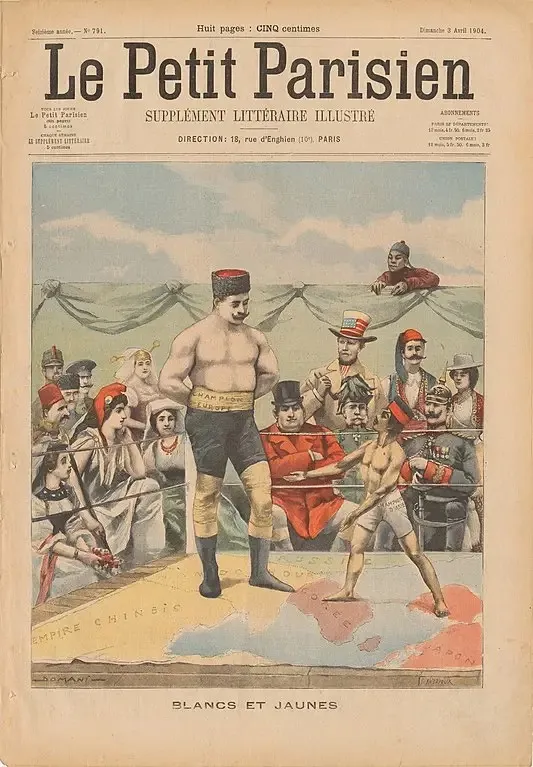
Published while the Russo-Japanese War was still young, the French weekly cover “Blancs et Jaunes” turned a conflict between two empires into a racial contest. It is a threshold image for the period after 1905 because it supplied a ready-made explanation for the possibility of Japanese victory: military competition could be understood as a challenge from an Asian “race” to a European one.
Close readingA towering Russian “Champion of Europe” faces a much smaller Japanese “Champion of Asia.” Their boxing ring is a map of China, Manchuria, Korea, and Japan, while European and American personifications crowd ringside and a Chinese figure peers over the curtain. The land and people most exposed to the war are reduced to the floor and margins of a spectacle organised for Western viewers.
Open source record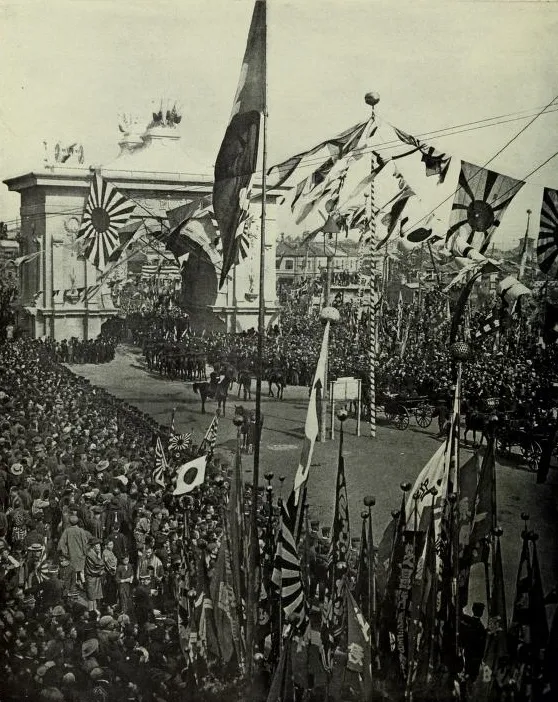
02 / Victory
Naval victory becomes public proof
Admiral Tōgō Heihachirō’s fleet destroyed the Russian Baltic Fleet at Tsushima in May 1905. His October return to Tokyo turned battlefield success into a mass civic ceremony. The photograph was subsequently reproduced for an English-language readership in The World’s Work, carrying the visual claim of Japanese naval modernity beyond the parade route.
Close readingMounted troops and carriages move through a canyon of spectators, standards, and Rising Sun flags toward a monumental arch. The elevated camera converts an unruly crowd into ordered depth. Modern Japan is not represented by a factory or classroom here, but by the state’s capacity to mobilise ships, soldiers, streets, print, and collective attention around victory.
Open source record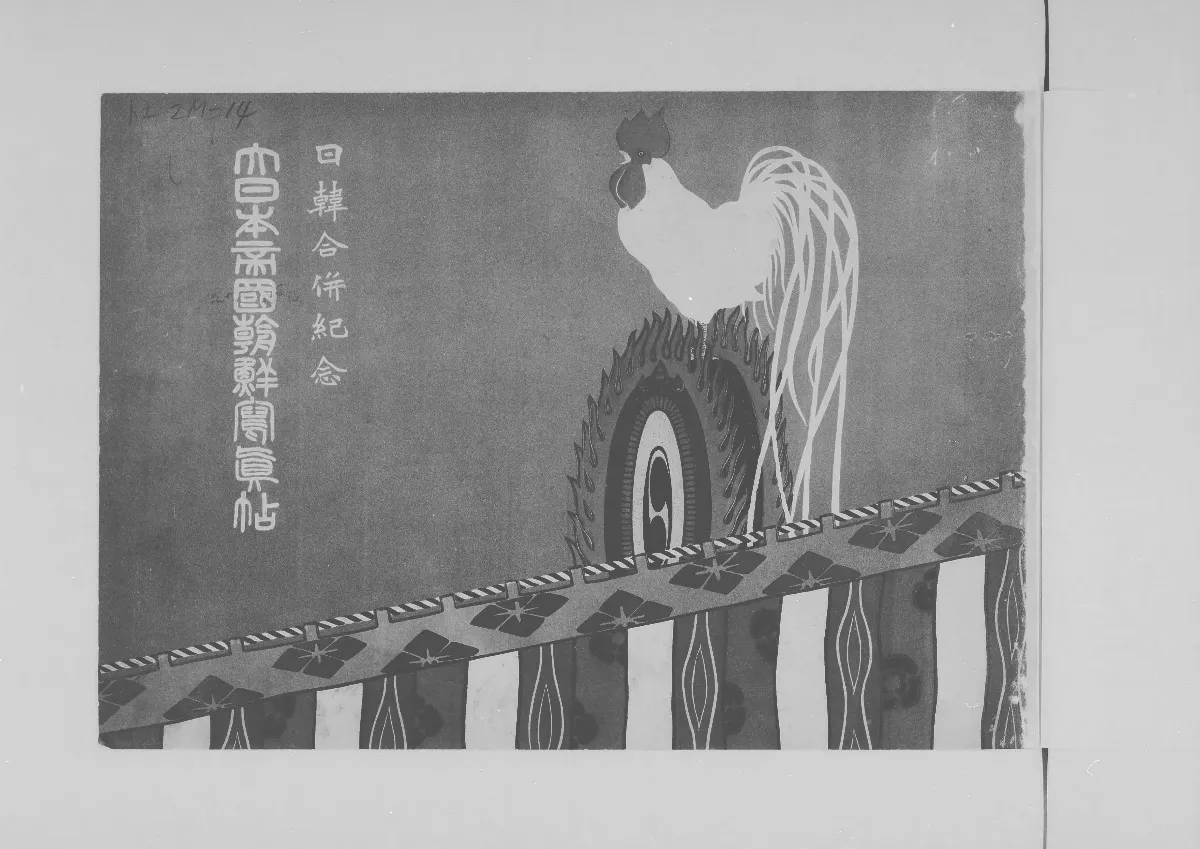
03 / Empire
The model power publishes its colony
In 1910 Japan formally annexed Korea after years of military pressure, treaty coercion, and rule through the Resident-General. The Resident-General’s own commemorative photographic album presented annexation as an accomplished imperial fact. It is evidence of colonial self-representation, not a neutral survey and not a record of Korean consent.
Close readingThe cover announces “Japan–Korea Annexation Commemoration” beside the title “Photographic Album of Korea in the Empire of Great Japan.” A rooster, radiant wheel, and patterned bands convert conquest into heraldic decoration. The confident graphic surface suppresses the force required to make Korea available for possession, classification, and display.
Open source record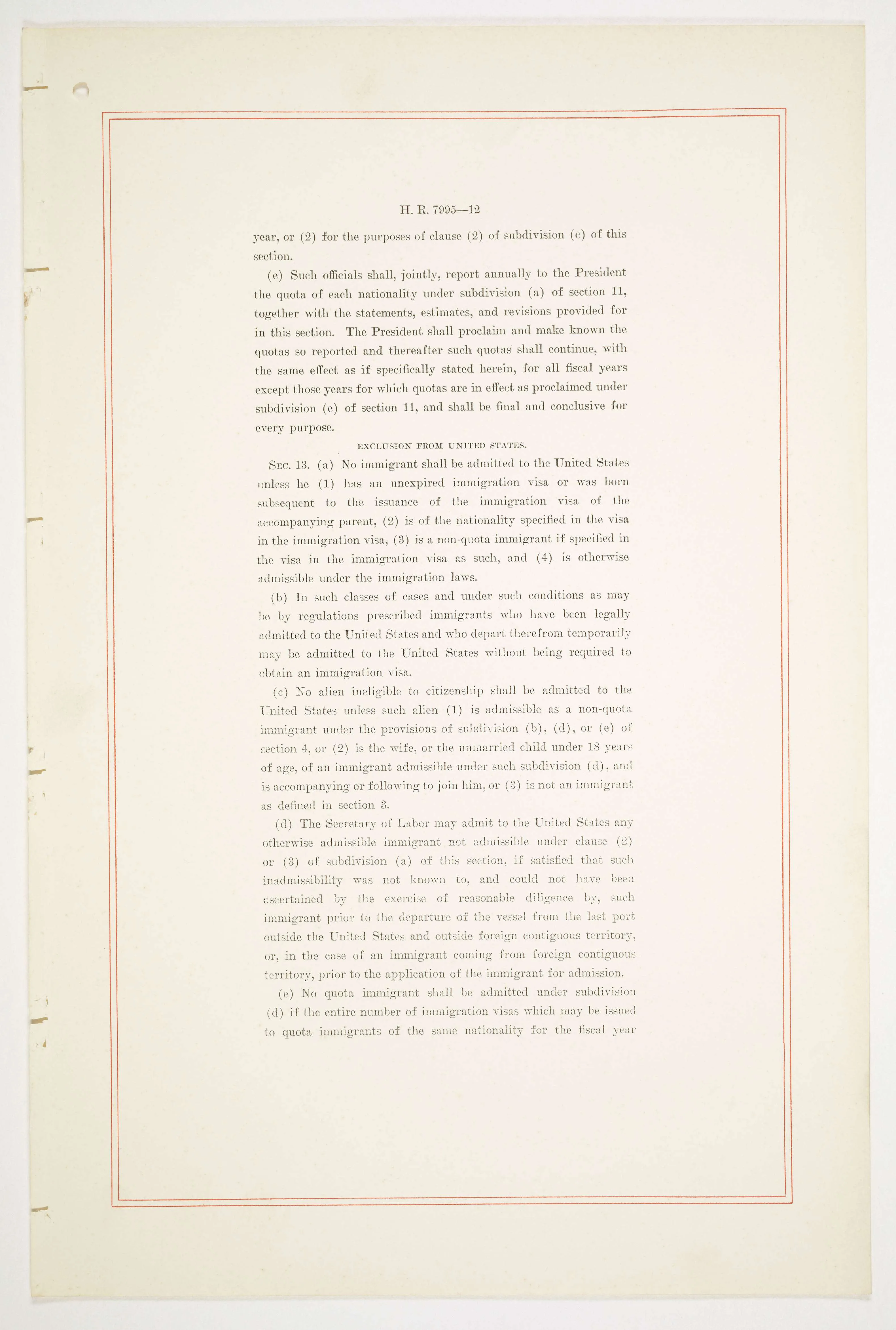
04 / Exclusion
Racial fear becomes an administrative clause
The Immigration Act of 1924 established national-origins quotas and barred immigrants deemed ineligible for U.S. citizenship. Because American naturalisation law and court decisions had excluded Japanese people from the racial category eligible for citizenship, section 13(c) effectively ended Japanese immigration. The statute translated agitation about race, labour, land, and national power into a durable border rule.
Close readingPage twelve is visually restrained: a red double rule surrounds evenly set legislative text. Under the heading “Exclusion from United States,” subsection 13(c) states that no alien “ineligible to citizenship” shall be admitted, subject to narrow exceptions. Japan is not named. The abstraction is the mechanism: a racial judgment made elsewhere enters the border as apparently impersonal administration.
Open source recordCounter-reading
Racism and imperial violence must remain visible together
Western racial hostility did not invent Japan’s empire, and Japan’s colonial violence did not make anti-Japanese racism an accurate description of Japanese migrants or people. The archive becomes most useful when those claims are held apart. One concerns a modern state exercising coercive power in Korea and China; the other turns ancestry into collective guilt and exclusion.
- 01Images of Japan as enlightened or equal often used the same racial and imperial vocabulary as images of menace; admiration did not necessarily escape hierarchy.
- 02Admission to the great-power table was measured through battleships, colonies, and diplomatic leverage, a standard Japan’s government actively pursued rather than merely receiving from Western observers.
- 03Korean and Chinese people cannot be treated as the background to Japan’s recognition. Their dispossession and resistance reveal the cost of the model-power narrative.
- 04Japanese migrants and their U.S.-born children were not extensions of Tokyo. Exclusionist rhetoric erased differences of citizenship, class, politics, generation, and individual life.
Evidence register
Sources in this chapter
- 01Blancs et JaunesLouis Andrieux (Domani)April 3, 1904An imperial war is staged as a contest between races
- 02The Triumphal Return of Admiral Togo from the Sea of JapanUnderwood & UnderwoodOctober 22, 1905; published 1907Military victory becomes a modern civic spectacle
- 03Commemorative Photographic Album of Korea in the Empire of Great JapanResident-General of Korea, compiler1910A colonial state converts annexation into commemorative design
- 04Immigration Act of 1924, Section 13(c)68th United States CongressMay 26, 1924Racial eligibility becomes a rule of admission
- 05The Yellow PerilUdo J. KepplerMarch 23, 1904A racialised title introduces an allegory of enlightened Japan
- 06No LimitLouis M. GlackensSeptember 22, 1909Great-power equality is measured in battleships