Chapter 08 · 1945–1991
Occupied Ally, Economic Rival
Occupation, security, and trade were not separate turns. The U.S.-led postwar order rebuilt Japan as a democratic ally and industrial partner, then treated the output of that same order as competition to contain.
Japan surrendered in August 1945 after a war that had devastated cities, displaced millions, and ended an empire across Asia and the Pacific. The Allied Occupation, directed by the United States until 1952, demilitarised the state, prosecuted selected leaders, revised institutions, and promoted a new democratic settlement. Japanese voters, organisers, officials, workers, and firms did not merely receive that settlement; they contested, used, and redirected it. As the Cold War hardened, reform gave way to strategic alliance and economic reconstruction. By the 1970s and 1980s, Western images increasingly located Japan not in ruins or under command but in factories, export statistics, and consumer markets. The former enemy had become an ally whose success could be pictured as a threat.
Evidence set6 objects · 1945–1981
Method noteMethod note: Five of this chapter’s six records were produced or preserved by United States government institutions. Their captions are evidence of official framing, not neutral descriptions. The sequence distinguishes occupation authorities, the postwar Japanese state, private firms, workers, voters, and consumers; it does not treat any of them as a single national actor.
The evidence sequence
Command staged, ballots cast, cars circulated, exports restrained
Scroll through 4 surviving objects. The image changes as the argument advances from one frame to the next.
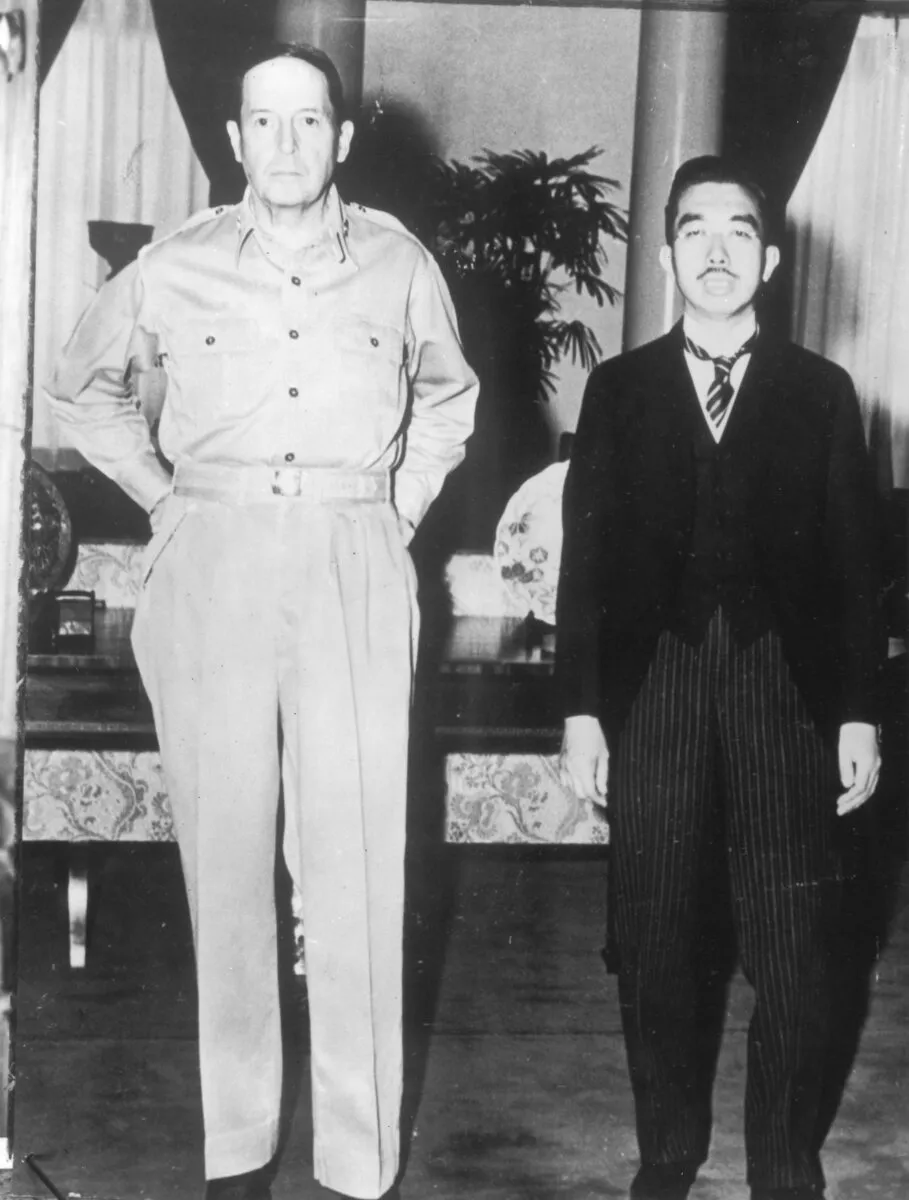
01 / Command
A portrait makes the new hierarchy visible
On September 27, 1945, Emperor Hirohito visited General Douglas MacArthur at the U.S. Embassy in Tokyo. Gaetano Faillace’s photograph was distributed in Japan and became one of the occupation’s defining images. It did not record an anonymous meeting. It staged two institutions—the imperial household and the Supreme Commander—at the moment their postwar relationship was being negotiated.
Close readingMacArthur fills the left side in an open-collared uniform, hands in his pockets and feet apart. Hirohito stands smaller, formally dressed, arms straight at his sides. The camera, clothing, posture, and unequal scale make command appear self-evident. Yet the image also records a bargain: occupation power retained the emperor rather than erasing the institution, using continuity to govern rupture.
Open source record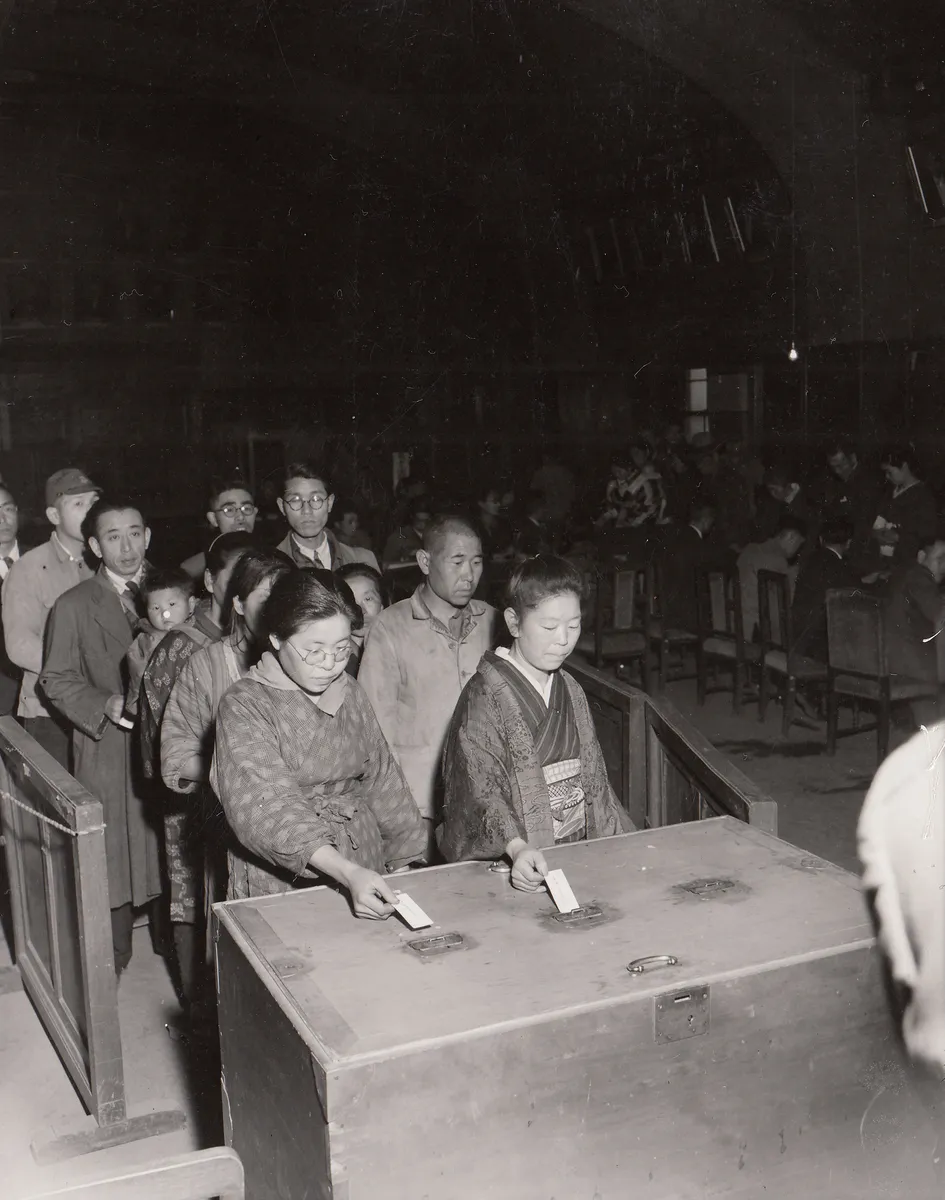
02 / Franchise
Reform becomes an act performed by voters
Japan’s first postwar general election took place on April 10, 1946, after a December 1945 legal reform extended the national franchise to women. Thirty-nine women won seats in the House of Representatives. This U.S. Army photograph shows voters at the Yotsuya Ward office in Tokyo. The official caption called the election Japan’s “first wobbly step” toward democracy, language that casts the Occupation as tutor and the electorate as pupil.
Close readingTwo women place ballots into a large locked box while a dense queue waits behind them. The camera catches neither a commander nor a constitutional author; it centres repeated civic action. The ballot box is bluntly material, and each slip passes through a voter’s hand. The image can therefore support a different account from its caption: democratic reform acquired meaning through Japanese participation, including women’s movements that predated 1945.
Open source record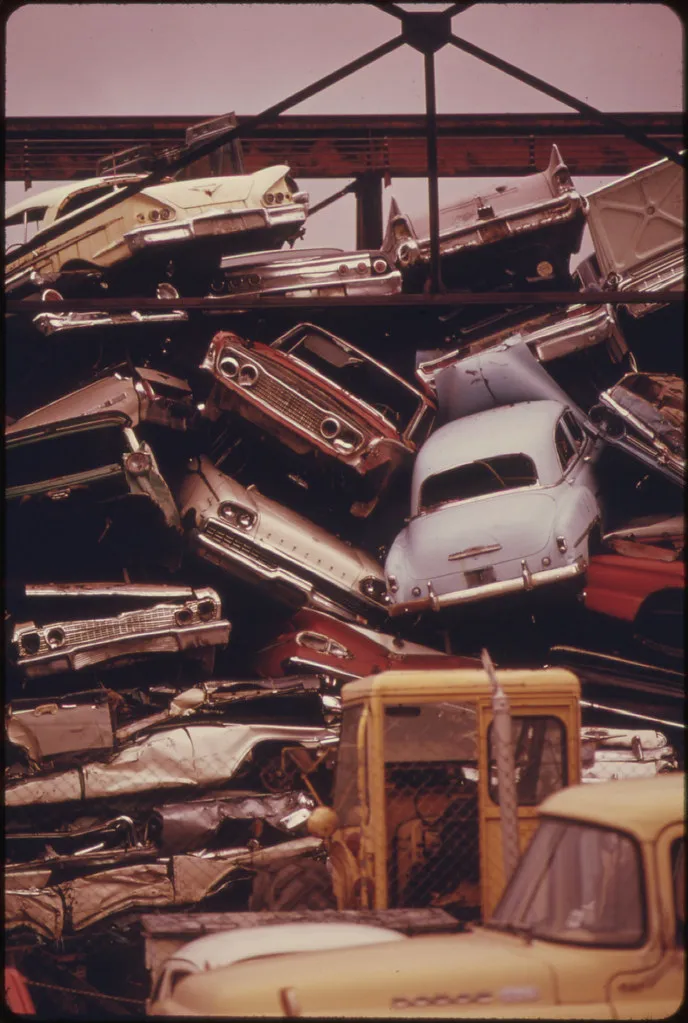
03 / Cycle
A recycling yard becomes a theory of trade
David Falconer made this Oregon photograph for the Environmental Protection Agency’s DOCUMERICA project. Its archival title claims that American cars were crushed and shipped to Japan, then returned as Toyotas and Datsuns “to begin the cycle once again.” Environmental documentation is turned into a compact story about industrial reversal.
Close readingA wall of obsolete American cars rises above the foreground truck. The compressed bodies are still recognisable by tail fins, chrome, and grilles—the visual language of earlier U.S. abundance. Japan is absent from the frame, present only in the caption as destination and returning competitor. That caption collapses raw material, labour, design, capital, shipping, dealerships, and consumer choice into a memorable national loop.
Open source record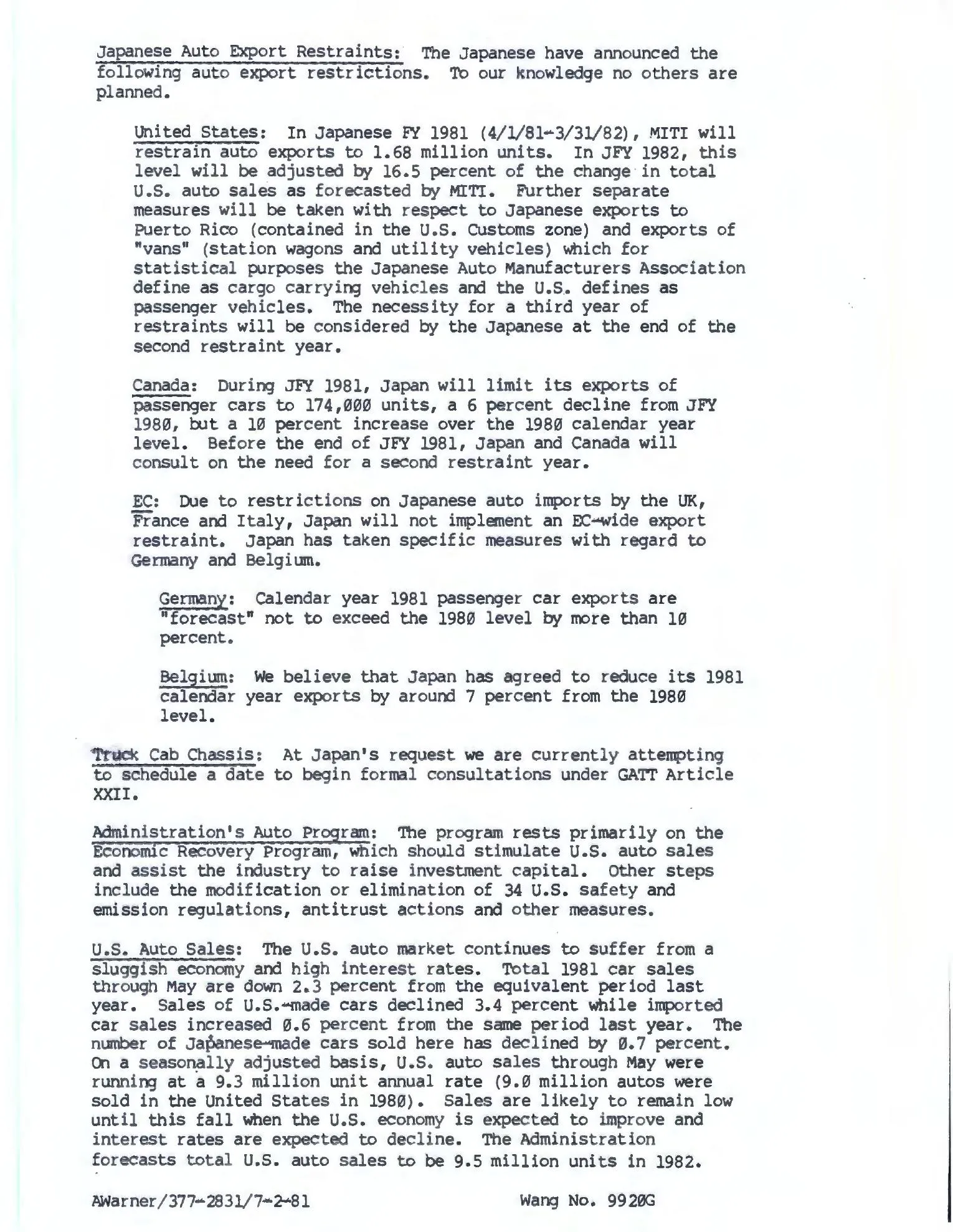
04 / Restraint
The ally is managed through a number
In 1981, under pressure from the United States and amid a severe downturn in the American automobile industry, Japan announced a voluntary restraint on passenger-car exports. This briefing page records a limit of 1.68 million units for Japanese fiscal year 1981 and presents the measure alongside comparable arrangements for Canada and European markets.
Close readingThe page replaces people and products with headings, percentages, and forecast formulas. “Japanese Auto Export Restraints” sits above country-by-country limits, while a later section promises American industry “breathing space.” The document does not describe a military enemy or alien civilisation. It renders a strategic ally as a measurable competitive pressure to be negotiated inside a shared economic order.
Open source recordCounter-reading
Neither democracy nor prosperity arrived as a finished American gift
Occupation reform, Cold War security, and export growth changed the institutions through which Japan was seen, but none was a single-direction transfer. Japanese political movements and voters shaped democratisation; workers and firms built industrial capacity; consumers in several countries made markets. At the same time, the 1951 Treaty of Peace with Japan restored sovereignty when it entered into force on April 28, 1952, while U.S. bases and a bilateral security regime continued. The alliance was contested, most visibly in the 1960 protests, and Okinawa remained under U.S. administration until 1972.
- 01The Army caption’s “first wobbly step” is a paternal framing. Women’s suffrage was enabled by occupation reform, but Japanese women’s movements and millions of voters were historical agents rather than proof of an American lesson successfully delivered.
- 02The security order joined restored sovereignty to continuing asymmetry. The 1951 photograph of Yoshida and Acheson records agreement, not unanimous consent or the lived geography of bases.
- 03Japan’s economic growth was not an innate national trait. State policy, private investment, organised labour, U.S. procurement, access to markets, and workers such as those at Camp Drake all belong in the explanation.
- 04DOCUMERICA’s “cycle” is an American caption imposed on a recycling-yard view. It makes a complex transpacific production system look like one nation converting another’s waste into victory.
- 05Export restraints managed competition within the alliance; they did not return Japan to the role of military enemy. “Threat” had moved from bodies and armies to market share, industrial policy, and trade balances.
Evidence register
Sources in this chapter
- 01General Douglas MacArthur and Emperor Hirohito at the U.S. EmbassyGaetano Faillace, U.S. Army Signal CorpsSeptember 27, 1945Occupation authority staged through posture, dress, and scale
- 02Voters at the Yotsuya Ward Office in Japan’s First Postwar General ElectionU.S. Army Signal Corps, photographer unknownApril 10, 1946Democratic reform seen through the actions of Japanese voters
- 03Stacked Autos Are Crushed and Shipped to Japan, Then Return as Toyotas and DatsunsDavid FalconerFebruary 1974Industrial competition condensed into a national recycling cycle
- 04Japanese Auto Export Restraints Briefing PaperU.S. Department of Commerce, International Trade AdministrationJuly 2, 1981An allied economy rendered as a quantified competitive pressure
- 05Shigeru Yoshida and Dean Acheson after the U.S.–Japan Security Treaty SigningU.S. Army Signal Corps, photographer unknownSeptember 8, 1951Restored sovereignty paired with an enduring American security presence
- 06Japanese Employees in the Ordnance Workshop at Camp DrakeU.S. Army Signal Corps, photographer unknownDecember 10, 1956Japanese labour inside the material infrastructure of the Cold War alliance