Chapter 04 · 1853–1868
Black Ships, Open Ports
The ports were not simply opened. Access was staged, negotiated, localised, and repeatedly enforced.
Commodore Matthew Perry entered Edo Bay with four American warships in July 1853, delivered President Millard Fillmore's letter, and returned with a larger squadron in 1854. The Convention of Kanagawa secured aid for shipwrecked sailors and access to Shimoda and Hakodate, but it was not a commercial treaty. Trade, extraterritorial rights, and additional treaty ports followed through the Harris Treaty of 1858 and related agreements. Images made this uneven process look at once like spectacle, accord, everyday contact, and military fact.
Evidence set6 objects · 1853–1864
Method noteThis sequence is weighted toward American, British, and treaty-port archives. Japanese prints provide essential counterviews, but neither side's images can stand for the full domestic contest over foreign relations or the experiences of people living beyond the ports.
The evidence sequence
How a forced encounter became an open-port order
Scroll through 4 surviving objects. The image changes as the argument advances from one frame to the next.
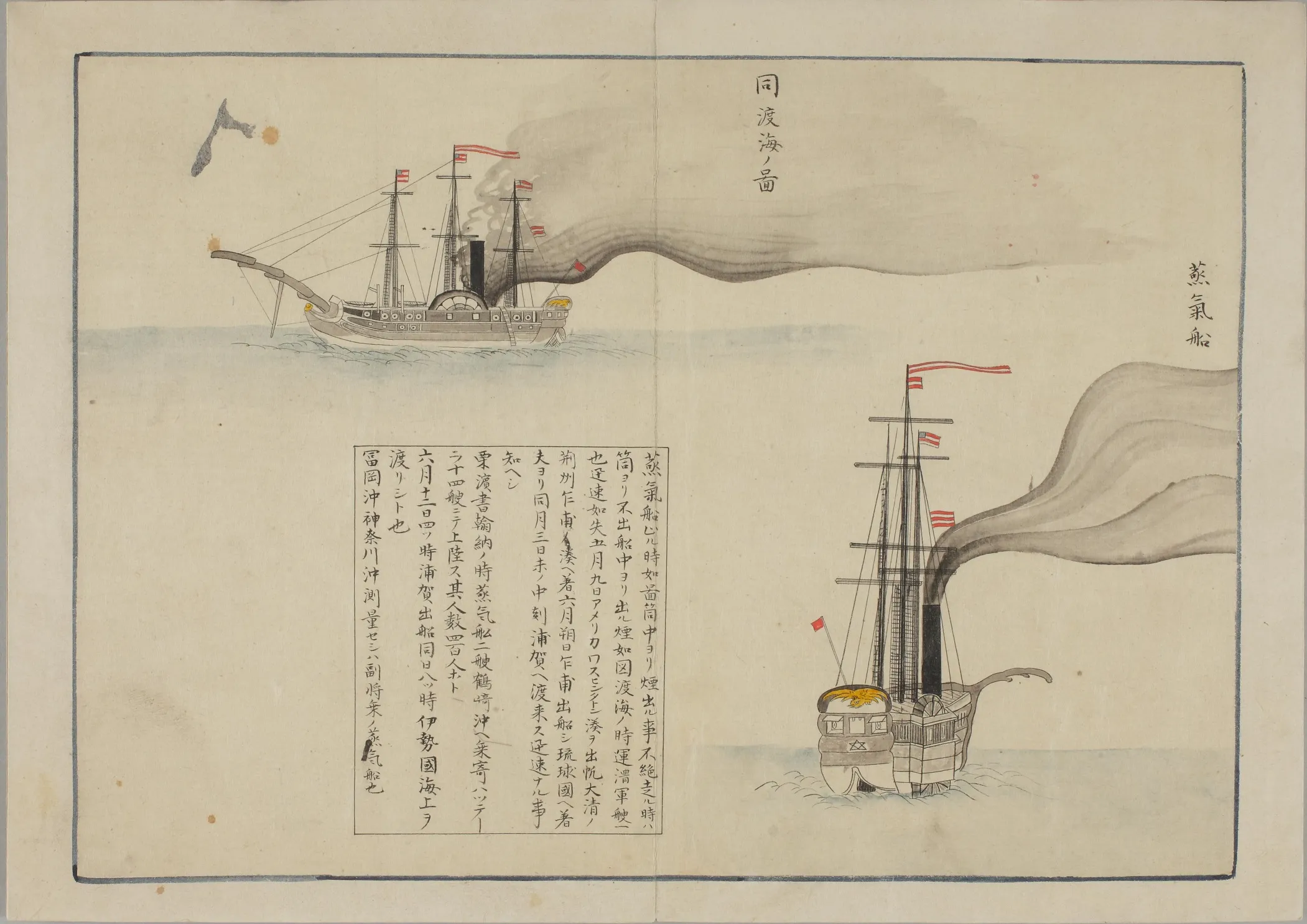
01 / Observation
The fleet becomes a diagram
A Japanese illustrated sheet records Perry's first squadron through routes, profiles, measurements, rigging, smoke, and explanatory notes. Alarm did not prevent observation; unfamiliar warships were rapidly converted into information that could circulate.
Close readingThe ships appear from the front, rear, and side rather than from one picturesque viewpoint. Repeated silhouettes and written dimensions break the threatening fleet into comparable parts, turning the black ships into a technical problem as well as a political one.
Open source record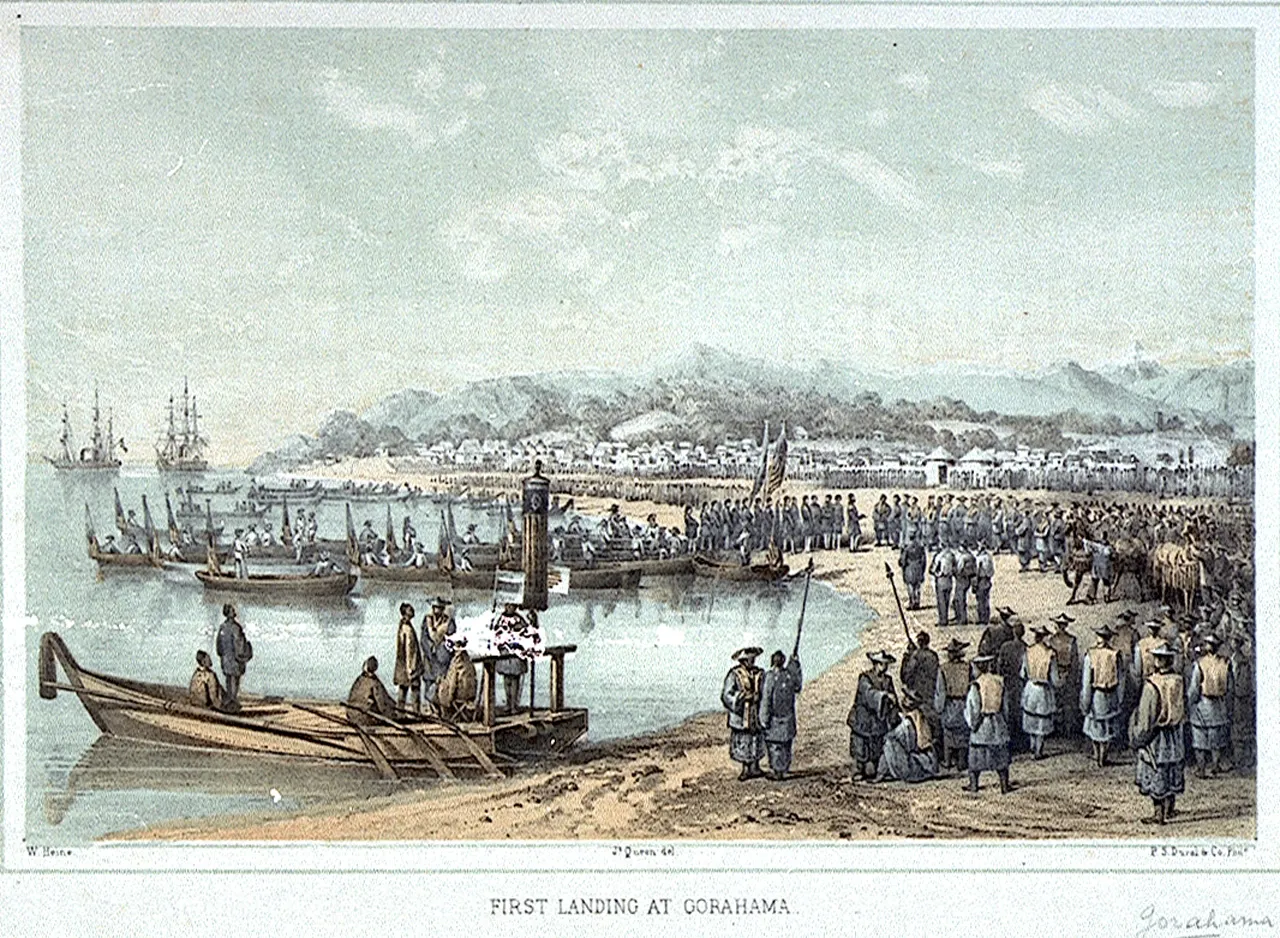
02 / Ceremony
The landing becomes inevitability
Published after the encounter, the American expedition image arranges Perry's men into disciplined ranks between landing boats and distant steamships. The delivery of a diplomatic letter is staged with the visual grammar of an amphibious military operation.
Close readingParallel lines of troops draw the eye toward the reception site while ships hold the horizon. Japanese spectators occupy the margins. Ceremony masks coercion by presenting armed order as the natural route to negotiation.
Open source record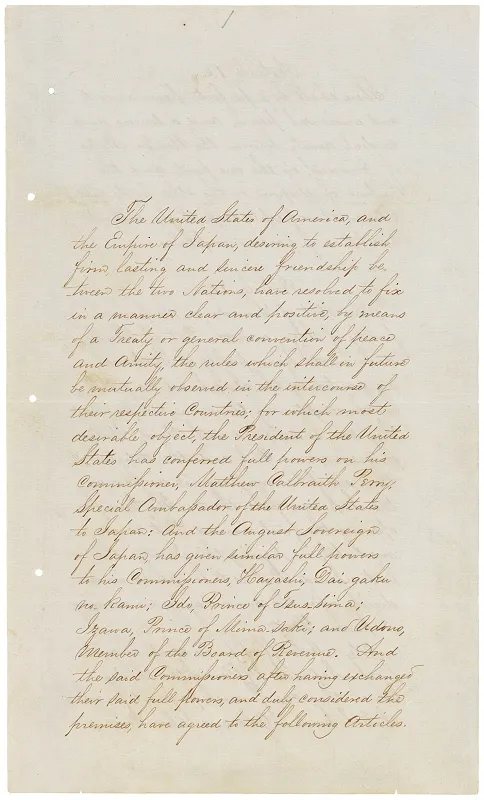
03 / Agreement
A limited accord becomes an opening
Signed on March 31, 1854, the Convention of Kanagawa provided assistance to American castaways, access to two ports for supplies, and the right to appoint a consul. It did not establish general trade; that expansion followed in 1858.
Close readingThe English version carries Perry's signature but no Japanese signatures. The National Archives explains the absence through a negotiated difference in signing custom. Even the document most often used to mark an opening records accommodation as well as pressure.
Open source record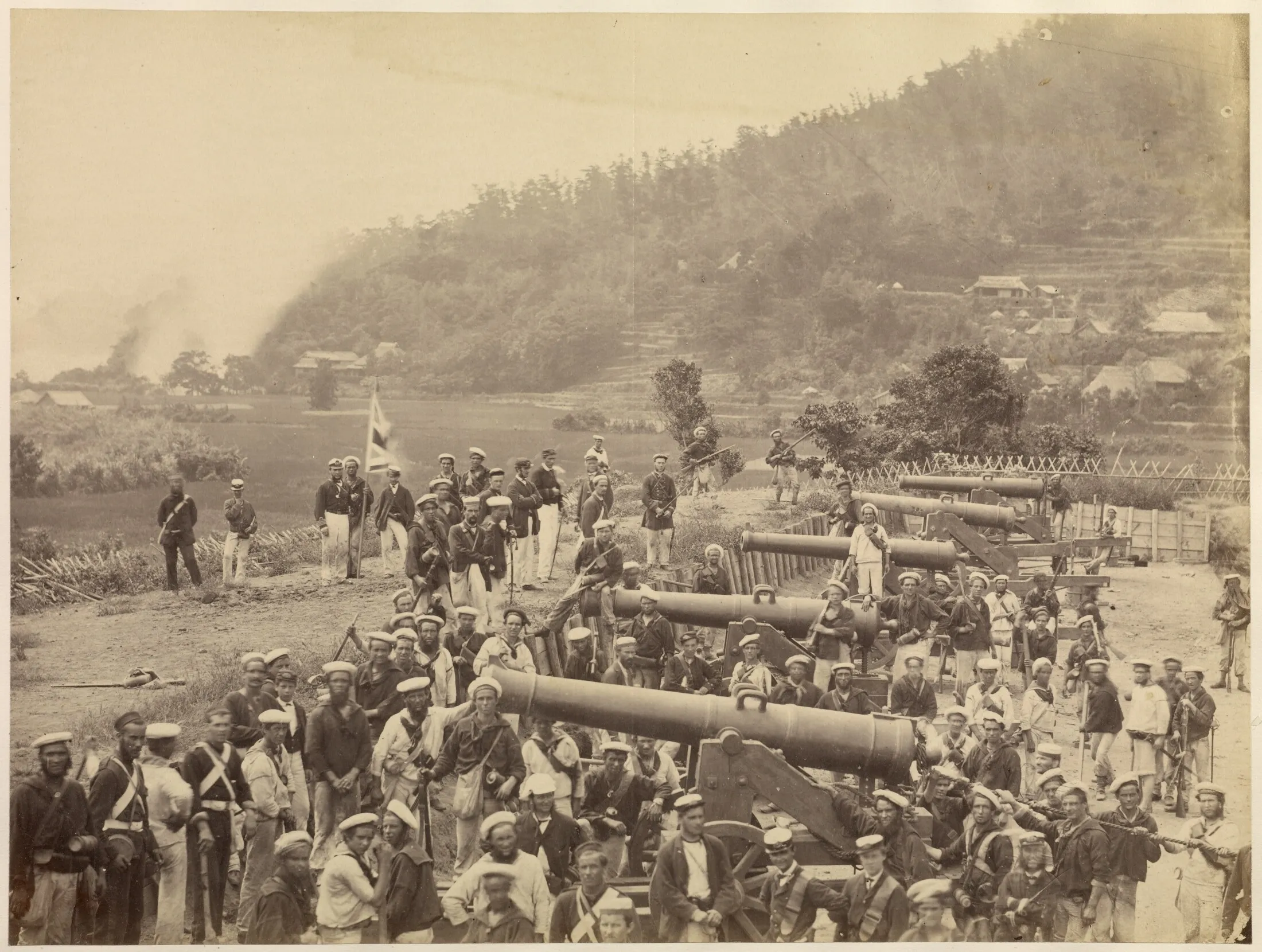
04 / Enforcement
Open passage remains backed by guns
In September 1864, British, French, Dutch, and American forces attacked Chōshū batteries that had fired on foreign shipping in the Shimonoseki Strait. Felice Beato photographed a British landing party after the Maedamura battery was taken.
Close readingSailors and marines pose around captured cannon beneath the Union Jack. The photograph turns seized weapons into trophies and fixes the treaty powers' demand for navigation as an accomplished military fact, a decade after Kanagawa.
Open source recordCounter-reading
“Opening” was not a single American act
Perry's expedition was decisive, but the familiar story compresses different treaties, ports, foreign powers, Japanese political actors, and episodes of violence into one sudden threshold. It also mistakes treaty-port imagery for transparent observation of a newly accessible nation.
- 01The Convention of Kanagawa supported American ships and castaways; the 1858 Harris Treaty created commercial access and extraterritorial privileges.
- 02Yokohama prints classified foreigners for a Japanese market, often through imagined interiors, so their detail cannot be read as neutral eyewitness documentation.
- 03Shimonoseki shows that foreign passage was still being imposed by a four-power coalition in 1864; neither open ports nor the Meiji Restoration followed automatically from one 1853 encounter.
Evidence register
Sources in this chapter
- 01Illustration of Foreign Ships from North AmericaUnidentified Japanese artist1853The fleet becomes technical information
- 02First Landing at GorahamaJames Queen, after Wilhelm Heine; P. S. Duval & Co.1856Diplomacy staged as disciplined arrival
- 03Treaty of Kanagawa, English-Language VersionGovernments of the United States and JapanMarch 31, 1854A conditional accord becomes an opening
- 04British Naval Landing Party in the Maedamura Battery, ShimonosekiFelice BeatoSeptember 6, 1864Open passage enforced by coalition violence
- 05Foreigners in the Drawing Room of Foreign Merchant's House in YokohamaUtagawa (Gountei) Sadahide9th month, 1861Treaty-port life imagined as interior order
- 06Foreigners Enjoying Themselves in the GankirōUtagawa Yoshikazuc. 1861The treaty port as managed entertainment